
Prophet Ibrahim (peace be upon him) showed his people that idols could not help anyone and that only Allah deserves worship. He broke their idols, and they threw him into a huge fire. Allah commanded, “O fire, be coolness and safety upon Ibrahim” (Qur’an 21:69), and he came out unharmed. Later he and his son Isma’il built the Kaaba (2:127).
What is the story of Prophet Ibrahim, retold for children?
Ibrahim, peace be upon him, grew up among idol-worshippers, called them to Allah, survived the fire by Allah’s command, and later built the Kaaba with his son. Each part below has its Qur’an or hadith reference.
Talking to his father
Ibrahim’s father, Azar, worshipped idols (6:74). Ibrahim spoke to him gently, again and again beginning “O my father”, and asked why he worshipped what cannot hear or see (19:42–45). When his father angrily told him to go away, Ibrahim answered, “Peace be upon you. I will ask my Lord to forgive you” (19:47).
Looking up at the sky
Ibrahim’s people also worshipped the stars. One night he saw a shining star and said, “This is my Lord.” When it set, he said, “I do not like things that set.” Then the bright moon rose, and then the great sun, but they set too. At last he said, “O my people, I am free of what you worship besides Allah. I have turned my face to the One who created the heavens and the earth” (6:76–79). Scholars explain that Ibrahim was reasoning with his people step by step, to show them that things which disappear cannot be God.
The broken idols
Ibrahim asked, “What are these statues you worship?” They said, “We found our fathers worshipping them” (21:52–53). When the people had gone out, he broke the idols into pieces, all except the biggest (21:57–58). The people were furious: “Who has done this to our gods?” (21:59). Ibrahim said, “Rather, this biggest one did it. Ask them, if they can speak!” (21:63). For a moment they knew the truth and said, “You know these cannot speak” (21:65). But they were too proud to change.
The fire
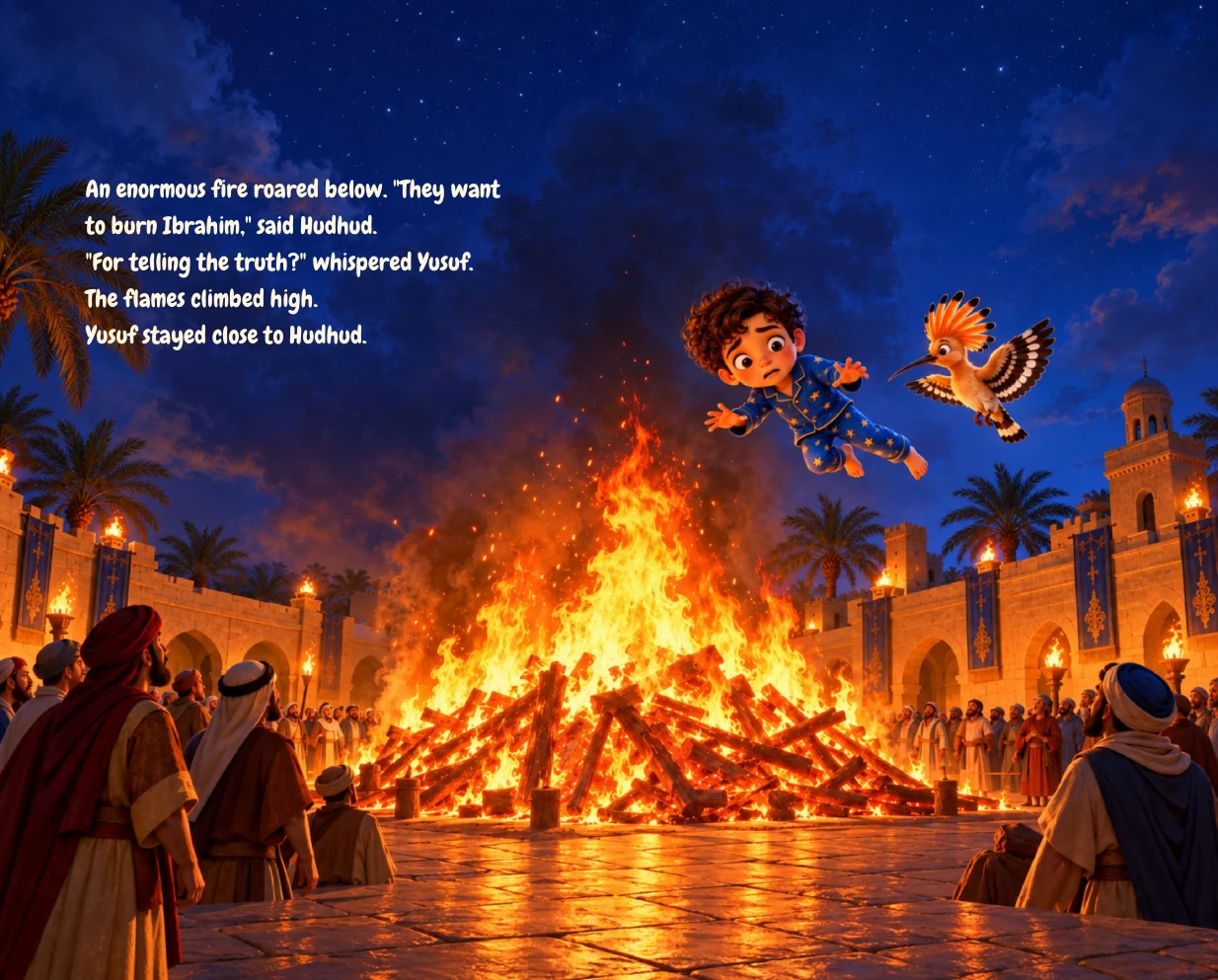
The people said, “Burn him, and support your gods” (21:68), and they threw Ibrahim into a blazing fire (37:97). Ibn Abbas reported that Ibrahim said, “Allah is enough for us, and He is the best Disposer of affairs”, Hasbunallahu wa ni’mal wakeel (Sahih al-Bukhari 4563). And Allah said: “O fire, be coolness and safety upon Ibrahim” (21:69). The fire could not hurt him.
The four birds
Ibrahim once asked Allah to show him how He gives life to the dead. Allah told him to take four birds, place parts of them on different hills and call them; and they came flying back to him (2:260). Children love this short story about Allah’s power.
Hajar, Isma’il and Zamzam
By Allah’s command, Ibrahim left his wife Hajar and baby Isma’il in a dry valley at Makkah, praying for them (14:37). Hajar asked him, “Has Allah commanded you to do this?” He said yes, and she said, “Then He will not neglect us.” When the water ran out, she ran between the hills of Safa and Marwa seven times, and Allah brought out the spring of Zamzam. Pilgrims still walk between those hills today (Sahih al-Bukhari 3364).
Building the Kaaba
Years later, Ibrahim and Isma’il raised the foundations of the Kaaba together, praying: “Our Lord, accept this from us. You are the All-Hearing, the All-Knowing” (2:127). Allah then told Ibrahim to call people to Hajj (22:27).
The dream and Eid al-Adha
Ibrahim saw in a dream that he was sacrificing his son. His son said, “Father, do as you are commanded; you will find me, if Allah wills, among the patient” (37:102). When they both submitted, Allah called out to Ibrahim and ransomed the son with a great sacrifice (37:104–107). The Qur’an does not name the son here; most scholars, including Ibn Kathir, held that it was Isma’il. Muslims remember this every year at Eid al-Adha.
What lessons does the story of Ibrahim teach children?
- Be gentle with parents. Even when his father was angry, Ibrahim said “Peace be upon you” (19:47).
- Think and ask questions. He pointed his people to the signs of Allah in the sky (6:75–79).
- Be brave for the truth. He spoke up, even alone (21:57–67).
- Trust Allah. When things look impossible, Allah is enough for us (Bukhari 4563).
- Be generous to guests. He hurried to bring a roasted calf for his visitors (11:69; 51:24–27).
How do you tell Ibrahim’s story to a 3–5-year-old vs a 6–9-year-old?
Under-fives need the idols and the cool fire; six- to nine-year-olds can follow the whole life, from the stars to the Kaaba, over a few nights.
| Ages 3–5 | Ages 6–9 | |
|---|---|---|
| Length | 3–5 minutes | Three short nights: idols and fire; Hajar and Zamzam; the Kaaba and the dream |
| Focus | Idols can’t help; Allah made the fire cool | Reasoning with his people; Hajar’s trust; building the Kaaba |
| The hard part | Leave out the dream for now | The dream: Allah tested them, they both obeyed, and Allah saved the son |
| Words to learn | “Allah is enough for me” | “Hasbunallahu wa ni’mal wakeel”; the dua of 2:127 |
| Try | Look at the moon together and say who made it | Build a model Kaaba; mark Safa and Marwa and walk between them |
A one-minute version for little ones: “Prophet Ibrahim knew that statues can’t hear or help. Only Allah can! He broke the statues to show his people. They were cross and threw him into a big fire. But Allah said, ‘Fire, be cool!’ And Ibrahim was safe. When we feel scared, we can say, ‘Allah is enough for me.’”
Which details are not in the Qur’an?
The Qur’an tells of a king who argued with Ibrahim about Allah (2:258) but does not name him; the name Namrud (Nimrod) comes from commentators and older traditions. Stories of Azar running an idol shop are also later additions. Keep to what the Qur’an and Sahih al-Bukhari report.
Questions to ask
- Why did Ibrahim leave the biggest idol unbroken?
- What did Allah tell the fire to be?
- What did Hajar say when she knew Allah had commanded it?
- Who helped Ibrahim build the Kaaba?
Ibrahim in the Hudhud book
In Hudhud, the child flies with Hudhud the hoopoe to see Ibrahim and the fire that Allah made cool, one of five Prophet stories in the book. For Eid al-Adha gift ideas linked to this story, see Eid al-Adha gifts for kids.
Previous story: Nuh and the Ark. Next: Musa and the parted sea.
Sources and further reading
Frequently asked questions
What happened when Prophet Ibrahim was thrown into the fire?
Allah commanded the fire, “O fire, be coolness and safety upon Ibrahim” (Qur’an 21:69), so it did not harm him. Ibn Abbas reported that Ibrahim said “Hasbunallahu wa ni’mal wakeel” as he was thrown in (Sahih al-Bukhari 4563).
Why did Ibrahim break the idols?
To show his people that idols cannot help, speak or even protect themselves, so only Allah deserves worship. He left the biggest one so they would ask it, and realise it could not answer (21:57–67).
What is the link between Ibrahim and Eid al-Adha?
Eid al-Adha remembers Ibrahim’s readiness to obey Allah when he saw in a dream that he should sacrifice his son, and how Allah ransomed his son with a great sacrifice (37:102–107).
Which son did Ibrahim almost sacrifice?
The Qur’an does not name him in 37:102. Most scholars, including Ibn Kathir, held that it was Isma’il, partly because the good news of Ishaq comes afterwards in the same passage (37:112).
Who built the Kaaba?
The Qur’an describes Ibrahim and his son Isma’il raising the foundations of the Kaaba and asking Allah to accept it from them (2:127).
What is the story of Hajar and Zamzam for kids?
Ibrahim left Hajar and baby Isma’il in the valley of Makkah by Allah’s command. When the water ran out she ran seven times between Safa and Marwa, and Allah brought out the spring of Zamzam (Sahih al-Bukhari 3364).
Is Ibrahim the same as Abraham?
Yes. Ibrahim is the Arabic name of the Prophet known in English as Abraham. The Qur’an calls him Khalil, a close friend of Allah (4:125).