
Prophet Musa (peace be upon him) was born when Pharaoh was harming the Children of Israel. Trusting Allah, his mother put him in a chest on the river, and Allah returned him to her. Later Allah sent him to Pharaoh. Trapped at the sea, Musa said, “My Lord is with me” (Qur’an 26:62), and Allah parted the sea.
What is the story of Prophet Musa, retold for children?
Musa, peace be upon him, was saved as a baby, grew up in Pharaoh’s own house, was chosen by Allah as a Prophet, and led the Children of Israel to safety through the sea. Each part below has its Qur’an reference.
A baby on the river
Long ago in Egypt, a cruel king, Fir’awn (Pharaoh), was hurting the Children of Israel and killing their baby boys (28:4). When Musa was born, Allah inspired his mother: “Nurse him, and when you fear for him, place him in the river and do not fear or grieve. We will return him to you” (28:7).
So she placed him in a chest and set it on the river (20:39). His sister followed it along the bank (28:11). Pharaoh’s family picked it up, and Pharaoh’s wife said, “A comfort for my eyes and yours. Do not kill him” (28:8–9). Baby Musa would not feed from any nurse, until his sister said, “Shall I show you a family who will look after him?” So Musa was returned to his own mother, just as Allah had promised (28:12–13).
Kindness at the well
When Musa was grown, he had to leave Egypt and went to Madyan (28:20–22). At a well he saw two young women waiting with their flock, and he watered their animals for them. Then he sat in the shade and prayed, “My Lord, I am in need of whatever good You send down to me” (28:23–24). Their father welcomed him, and Musa stayed in Madyan for years and married there (28:25–29).
The fire on the mountain
Travelling with his family, Musa saw a fire by the side of the mount (28:29). He went to it, and Allah called to him in the sacred valley of Tuwa: “Indeed, I am Allah. There is no god except Me” (20:12–14). Allah told Musa to throw down his staff, and it became a moving snake; when he picked it up, it became a staff again. His hand came out shining white (20:17–22).
Musa was worried about speaking, so he made a beautiful dua: “My Lord, expand for me my chest, ease for me my task, and untie the knot from my tongue so they understand my speech” (20:25–28). Allah made his brother Harun a Prophet to help him (20:29–36).
Speaking to Pharaoh gently
Allah sent Musa and Harun to Pharaoh and told them: “Speak to him with gentle words, so that perhaps he may remember or fear Allah” (20:44). Pharaoh refused, even after he saw Allah’s signs, and even after his own magicians fell down in prostration and believed (20:70).
The parted sea
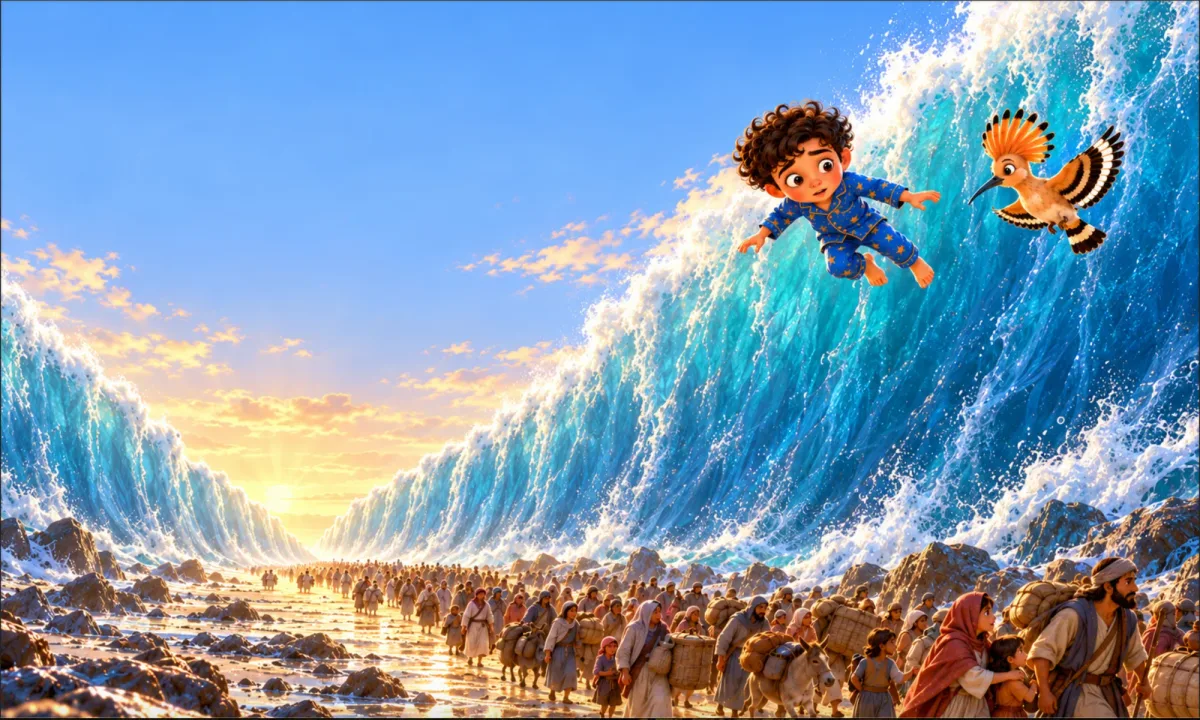
Allah told Musa to lead the Children of Israel out by night (26:52). Pharaoh chased them with his army. At the sea the people cried, “We are caught!” But Musa said: “No! My Lord is with me. He will guide me” (26:61–62). Allah told Musa to strike the sea with his staff, and it split, each side like a huge mountain (26:63). The believers crossed safely; when Pharaoh followed, the waters closed over him and his army (26:65–66).
What lessons does the story of Musa teach children?
- Trust Allah’s promise. Musa’s mother trusted Allah, and He returned her baby (28:13).
- Help without being asked. Musa watered the women’s flock, then asked only Allah (28:24).
- Ask Allah for help. Musa’s dua (20:25–28) is perfect before school or speaking in front of others.
- Be gentle, even with difficult people. Allah told Musa to speak gently even to Pharaoh (20:44).
- Allah makes a way. When there seemed to be no way out, Allah opened a path through the sea (26:63).
How do you tell Musa’s story to a 3–5-year-old vs a 6–9-year-old?
For under-fives, tell the baby on the river and the parted sea as two separate bedtime stories. For six- to nine-year-olds, tell the full life in three or four parts.
| Ages 3–5 | Ages 6–9 | |
|---|---|---|
| Length | 3–5 minutes per scene | Four nights: the river; Madyan; the call and Pharaoh; the sea |
| Focus | Allah kept baby Musa safe; Allah opened the sea | Trust, courage, gentle speech, and Allah’s signs |
| The hard part | “Pharaoh was unkind”: no need for more | Why Musa left Egypt: a man died after Musa struck him, and Musa asked Allah’s forgiveness (28:15–16) |
| Words to learn | “My Lord is with me” | “Rabbish rahli sadri wa yassir li amri” (20:25–26) |
| Try | Float a little basket in the bath | Fast or mark ‘Ashura together, and say why |
A one-minute version for little ones: “A mummy put her baby, Musa, in a little box on the river, because Allah told her He would keep him safe. And Allah did! When Musa grew up, he led his people away from a cruel king. They came to the sea and couldn’t go any further. But Musa said, ‘My Lord is with me!’ Allah opened a path right through the sea, and they walked across safely.”
Which details are not in the Qur’an?
The Qur’an speaks of a fire seen by the mount and a call “from the tree” (28:29–30), rather than the Bible’s “burning bush”. It does not name Pharaoh’s wife; the name Asiya comes from hadith, where the Prophet named her among the best of women (Sahih al-Bukhari 3411). Her own dua for a house in Paradise is in the Qur’an (66:11), a lovely one for older children. Keep the ten plagues of the Bible separate: the Qur’an lists its own signs, such as the flood, locusts, lice, frogs and blood (7:133).
Questions to ask
- How do you think Musa’s mother felt when she put the box in the river?
- What did Musa say when everyone thought they were trapped?
- Why do you think Allah told Musa to speak gently to Pharaoh?
- When could you use Musa’s dua?
Musa and ‘Ashura
When the Prophet Muhammad (peace be upon him) came to Madinah, he found the Jews fasting on ‘Ashura, the day Allah saved Musa and his people. He said, “We have more right to Musa than you,” fasted it and told Muslims to fast it (Sahih al-Bukhari 2004). It’s a good day to retell this story every year.
Musa in the Hudhud book
In Hudhud, the child and the hoopoe fly beside the parted sea, one of five Prophet stories in the book. For confident readers, Saniyasnain Khan’s Tell Me About the Prophet Musa (Goodword) tells his life in more detail; see more in our Prophet stories for kids guide.
Previous: Ibrahim and the fire. Next: Isa, son of Maryam.
Sources and further reading
Frequently asked questions
Why was baby Musa put in the river?
Pharaoh was killing the baby boys of the Children of Israel, so Allah inspired Musa’s mother to place him in the river, promising to return him to her (Qur’an 28:7). Allah kept His promise, and she nursed him in Pharaoh’s own house (28:12–13).
What did Musa say at the sea?
When his people feared being caught, Musa said, “No! My Lord is with me. He will guide me” (26:62). Then Allah told him to strike the sea with his staff and it parted (26:63).
What is the dua of Prophet Musa?
“Rabbish rahli sadri wa yassir li amri wahlul ‘uqdatan min lisani yafqahu qawli”: “My Lord, expand for me my chest, ease for me my task, and untie the knot from my tongue so they understand my speech” (20:25–28).
Who was Pharaoh’s wife in the story of Musa?
The Qur’an tells of her saving baby Musa (28:9) and of her dua for a house in Paradise (66:11). The hadith names her Asiya and counts her among the most perfect of women (Sahih al-Bukhari 3411).
Why do Muslims fast on ‘Ashura?
The Prophet Muhammad fasted on ‘Ashura, the day Allah saved Musa and the Children of Israel from Pharaoh, and told Muslims to fast it (Sahih al-Bukhari 2004). It falls on the 10th of Muharram.
Is Musa the same as Moses?
Yes. Musa is the Arabic name of the Prophet known in English as Moses. He is named in the Qur’an more often than any other Prophet.